
PFAS REMOVAL FROM DRINKING WATER AND WASTEWATERWater utilities · Wastewater treatment plants · Industry · Households
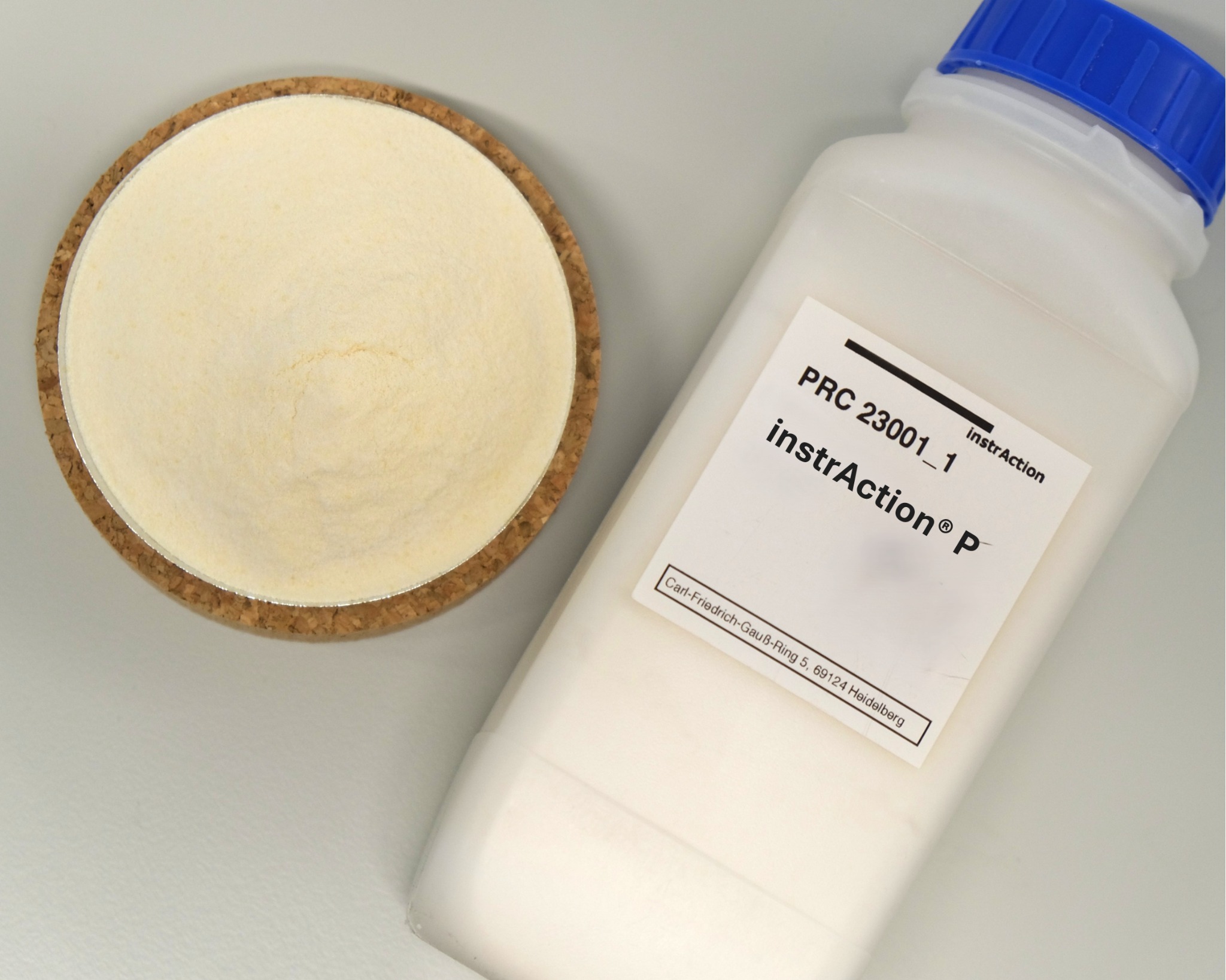
instrAction P filter medium and original packaging
INNOVATION IN PFAS REMOVAL

instrAction technology.
Designed for selectivity.

Rapid, targeted PFAS binding in compact filter assemblies. Advanced technology for demanding water treatment applications.

INSTRACTION TECHNOLOGY (iA)

Innovation starts
at the binding site.

instrAction develops filter media with specifically designed functional groups. These are chemical binding sites tailored to capture selected contaminants. The iA P series is developed for short- and long-chain PFAS.

The foundation is hydrogel chemistry: in contact with water, the polymer structure provides access to binding sites. In P media, a functionalised polyamine combines selective chemistry with a stable support. As water passes through, PFAS bind to the medium and remain in the filter.

The abbreviation iA stands for intelligent Absorber. The innovation combines selectivity, binding speed and suitability for compact filter designs.

instrAction technology – intelligent AbsorberPURPOSE-DESIGNED
for PFAS capture
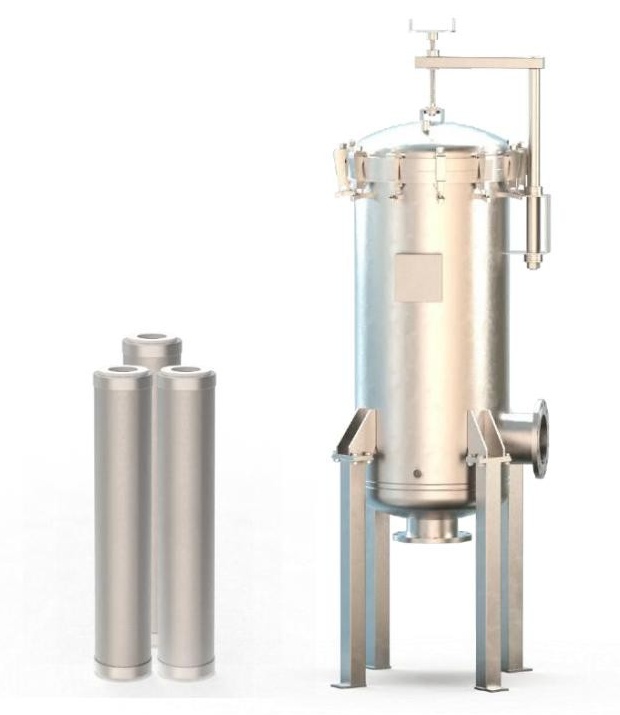
instrAction industrial housing with filter cartridges
VIDEO · INSTRACTION

Discover how iA technology works.

Clicking loads the YouTube player, which receives connection data.

Watch on YouTube
HOW IT WORKS

From PFAS in water
to their capture.

PFAS can be dissolved in water. Their capture therefore relies on binding to a dedicated medium.

01 / CONTACT WITH THE MEDIUM

Water reaches the binding sites.

Water flows through the filter bed. Cartridge design and media distribution bring dissolved PFAS into contact with functional groups. Where needed, pretreatment retains particles and prepares the water for the dedicated stage.
02 / SELECTIVE BINDING

PFAS compounds are retained in the filter.

The iA P series is designed for short- and long-chain PFAS. Accessible binding sites enable rapid capture, important at higher flow rates and shorter water–media contact times.

03 / PERFORMANCE MONITORING

Controlled operation.

We monitor performance by sampling inlet and outlet water. Two consecutive filtration stages provide additional outlet control, while parallel housings increase total flow. Replacements are planned according to loading and results.

ADVANTAGES COMPARED WITH GAC AND IEX

Purpose-designed chemistry.
Practical advantages.

The advantages of iA are reflected in its capture mechanism and test results: high efficiency even at higher media loading rates.

COMPARED WITH GAC

Targeted PFAS capture.

Granular activated carbon uses a porous surface for adsorption. instrAction technology uses binding sites specifically designed for PFAS. The P series is developed to capture both short- and long-chain compounds.

A benefit for system design: rapid binding enables more water to be treated per unit volume of media. In system design, this creates the potential for a smaller filter bed and a more compact installation at the same flow rate.

COMPARED WITH IEX

High performance at higher loading rates.

PFAS-specific IEX uses anion-exchange media. instrAction is based on a functionalised hydrogel platform. Comparative measurements best demonstrate the differences between configurations.

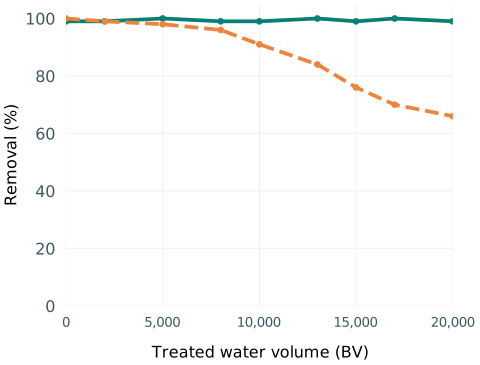
In the tests shown, iA P 425 maintains higher PFAS removal efficiency than the tested IEX as the loading rate and treated water volume increase. This supports efficient media utilisation and compact industrial design.

FROM INNOVATION TO INDUSTRIAL APPLICATION

Compact design.
Room for higher flow.

We combine iA P BIG cartridges in multi-filter housings. Cartridge number and length determine each assembly’s capacity, while parallel housings increase the system’s total flow.

For industrial sizing, we use a range of 100–250 BV/h, adapted to water composition. BV/h expresses hourly water throughput relative to media volume. The selected loading rate and capacity are confirmed by testing the client’s water.

iA PERFORMANCE · TEST RESULTS

An advantage
demonstrated by measurements.

How well does iA capture PFAS at higher loading rates and after treating more water? Explore key comparative test results.

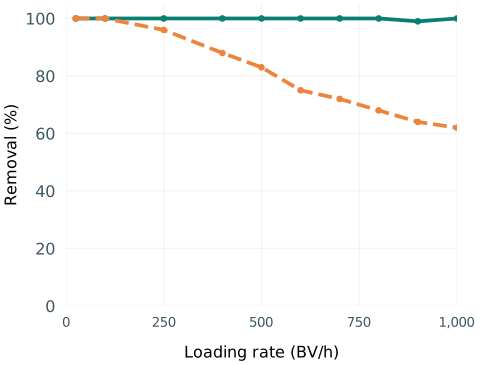
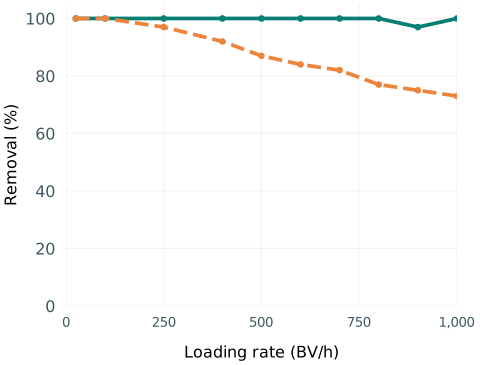
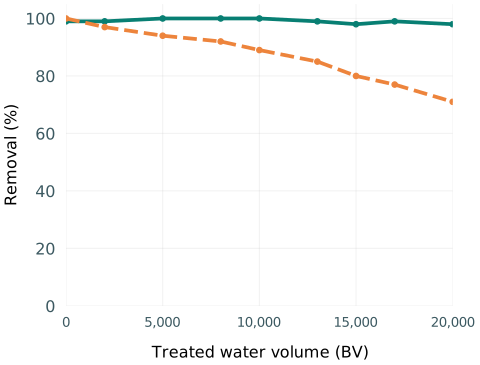
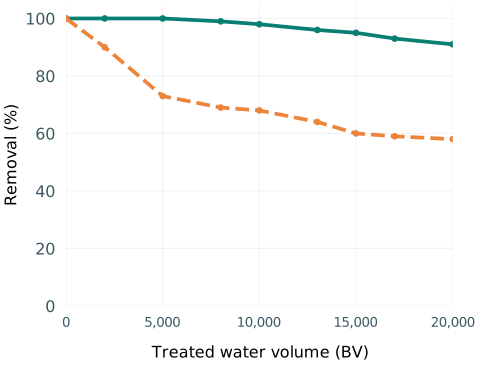
Simplified charts of instrAction laboratory tests compare iA P 425 and the tested IEX. Three PFAS compounds are shown; the results describe the stated media test, not a complete industrial assembly.

Samples for laboratory assessment of filtration efficiency
01 / BINDING RATE

Performance at higher loading rates.

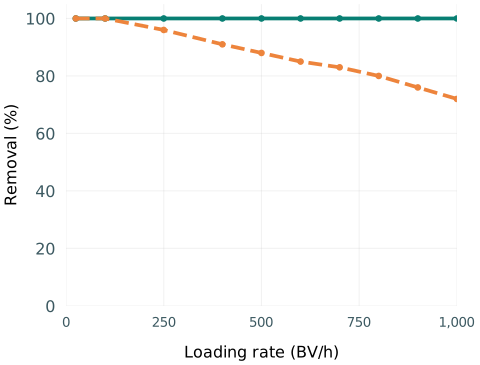
Increasing loading rate: up to 1,000 BV/h

iA · P 425 testTested IEX

PFOA (C8)

PFOA removal chart: iA maintains higher performance while the tested IEX declines with loading rate or treated volume. Approximate test trend.

PFHxA (C6)

PFHxA removal chart: iA maintains higher performance while the tested IEX declines with loading rate or treated volume. Approximate test trend.

PFBS (C4)

PFBS removal chart: iA maintains higher performance while the tested IEX declines with loading rate or treated volume. Approximate test trend.

Simplified test curves based on the original charts. Values are approximate readings; lines between selected points indicate the trend.

What does the chart show?

As loading increases, the green iA curves remain close to 100%. The orange curves for the tested IEX decline. In this test, iA maintains high PFAS capture even with shorter water contact time.

1,000 BV/h is a comparison point in the laboratory test. For industrial assemblies, we use a design range of 100–250 BV/h, confirmed by testing the actual water.

02 / TREATED WATER VOLUME

Sustained performance during operation.

Treated volume: up to 20,000 BV at a constant 25 BV/h

iA · P 425 testTested IEX

PFOA (C8)

PFOA removal chart: iA maintains higher performance while the tested IEX declines with loading rate or treated volume. Approximate test trend.

PFHxA (C6)

PFHxA removal chart: iA maintains higher performance while the tested IEX declines with loading rate or treated volume. Approximate test trend.

PFBS (C4)

PFBS removal chart: iA maintains higher performance while the tested IEX declines with loading rate or treated volume. Approximate test trend.

Simplified test curves based on the original charts. Values are approximate readings; lines between selected points indicate the trend.

What does the chart show?

As more water passes through the medium, the tested IEX gradually loses efficiency. iA remains close to 100% for PFOA and PFBS, while PFHxA falls to approximately 90% towards the end. The difference demonstrates better retention of iA performance under the test conditions.

WHY iA

Binding sites
designed for target substances.

iA technology uses functional binding sites for selective PFAS capture. The large number and accessibility of these sites enable instrAction’s rapid binding.

Advantage over the tested IEX

The tests show higher performance at greater loading rates and treated volumes. For operators, this offers the potential for a more compact design and better media utilisation.

Advantage over GAC

instrAction’s technology comparison assumes 2–5 BV/h for GAC and 100–200 BV/h for iA filter assemblies. A higher loading rate means less media volume at the same flow and the potential for a smaller installation.

FROM CAPTURE TO FINAL TREATMENT

The complete process is part of the solution.

Adsorption transfers PFAS from water onto the medium. Subsequent handling is a separate, essential part of the project.

01 / ANALYSIS AND TESTING

From sample to design

Laboratory analysis identifies the PFAS present and their concentrations, alongside checks of flow and water composition. Laboratory or pilot testing on actual water assesses filter performance and capacity, providing a basis for system sizing.

02 / SELECTIVE FILTRATION

A solution for your water

Based on the results, we select suitable iA filter assemblies, pretreatment and the number of filtration stages. The system is tailored to required flow and outlet quality. Sampling monitors performance and informs timely filter replacements.

03 / MEDIA MANAGEMENT

Destruction of spent filters

We arrange collection of spent filters containing captured PFAS and their destruction by high-temperature incineration at an authorised facility, under conditions suitable for PFAS destruction. This removes the captured PFAS from the water cycle.

ECO ELEMENT · TALK TO A SPECIALIST

Let’s find the right solution for your water.

Describe your problem or ask us a question. We will get back to you as soon as possible.

Send an enquiry