GAC, IEX or instrAction?
Performance, space requirements and costs depend on the water being treated. Comparison helps identify a starting point for your project.
Why choose instrAction?
Selective PFAS filtration with advantages in design, filter replacement and operation. Compare the key differences in one place.
| Criterion | GACGranular activated carbon | IEXPFAS-selective anion-exchange resin | Technology advantagesinstrActionSelective filtration · iA assemblies |
|---|---|---|---|
| PFAS capture mechanism | Adsorption onto porous activated carbon. | Ion exchange on a dedicated anion-exchange resin. | Selective PFAS removal Purpose-designed instrAction binding sites selectively capture PFAS on a hydrogel platform. |
| Short and long chains | Activated carbon generally retains long-chain PFAS more effectively. | Dedicated resins for capturing anionic PFAS. | Capturing short and long chains The technology is developed for selective capture of short- and long-chain PFAS. |
| Binding rate | Treatment in an activated carbon bed with a longer contact time. | Treatment in an ion-exchange resin bed. | Rapid binding. High flow rates. Rapid binding enables high-flow filtration; the tests shown demonstrate an advantage over the tested IEX. |
| System compactness | In this comparison: 2–5 BV/h. | In this comparison: 10–20 BV/h. | Less media for the same flow In this comparison: 100–200 BV/h. A higher loading rate means less media is needed at the same flow rate. |
| Increasing flow | Adding or enlarging adsorption vessels. | Adding or enlarging resin vessels. | Capacity grows with your needs Total flow has no predefined upper limit. BIG filter assemblies are connected in parallel for higher water flow; their number and design are tailored to each project's requirements and hydraulic conditions. |
| Integration into an existing system | Carbon vessels, associated pipework and media replacement space. | Resin vessels, associated pipework and maintenance access. | Flexible integration Cartridge design enables flexible installation and integration of a dedicated PFAS stage into existing treatment. |
| Maintenance and operation | Bulk carbon replacement and arrangements for spent-media handling. | Resin replacement and arrangements for spent-media handling. | Easier handling during replacement Replaceable cartridges enable planned maintenance. We combine analysis, replacements and filter collection into comprehensive client support. |
| Total costs | Investment, operation, carbon replacement and spent media management. | Investment, operation, resin replacement and spent media management. | Lower costs in the illustrated scenario The existing calculation shows a lower total cost for iA than for GAC and IEX for investment and ten years of operation. Actual costs depend on the project. View the CAPEX / OPEX calculation |
| After media exhaustion | Further handling of the carbon and captured PFAS must be planned. | Further handling of the resin and captured PFAS must be planned. | Organised filter collection and incineration We arrange collection of spent filters containing captured PFAS and high-temperature incineration at an authorised facility under conditions suitable for PFAS destruction. From capture to final treatment |
We compare designs. We confirm performance on your water. The loading rates refer to the illustrated comparison, not to all GAC and IEX products. Higher BV/h means a smaller media volume for the same flow; it does not directly represent footprint savings. Performance, service life and costs are assessed against the individual PFAS, water composition and required outlet quality.
What do the different configurations look like?
From industrial adsorbers to cartridge housings. The photographs show equipment designs; a space comparison is then prepared for your flow rate.
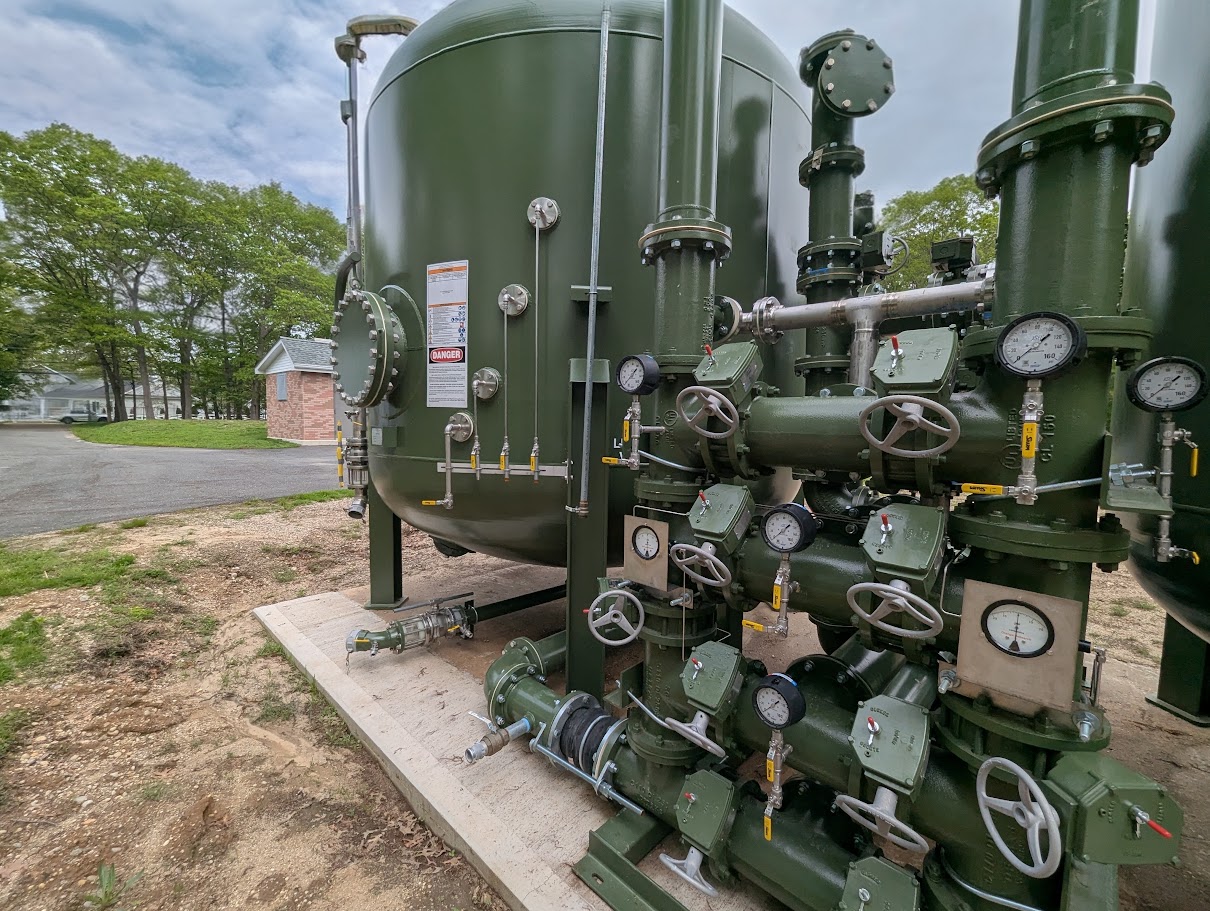
Granular activated carbon
Larger vessels with a media bed, pipework and space for maintenance and carbon replacement.
GAC vessels at a water supply station. Photo: Suffolk County Water Authority.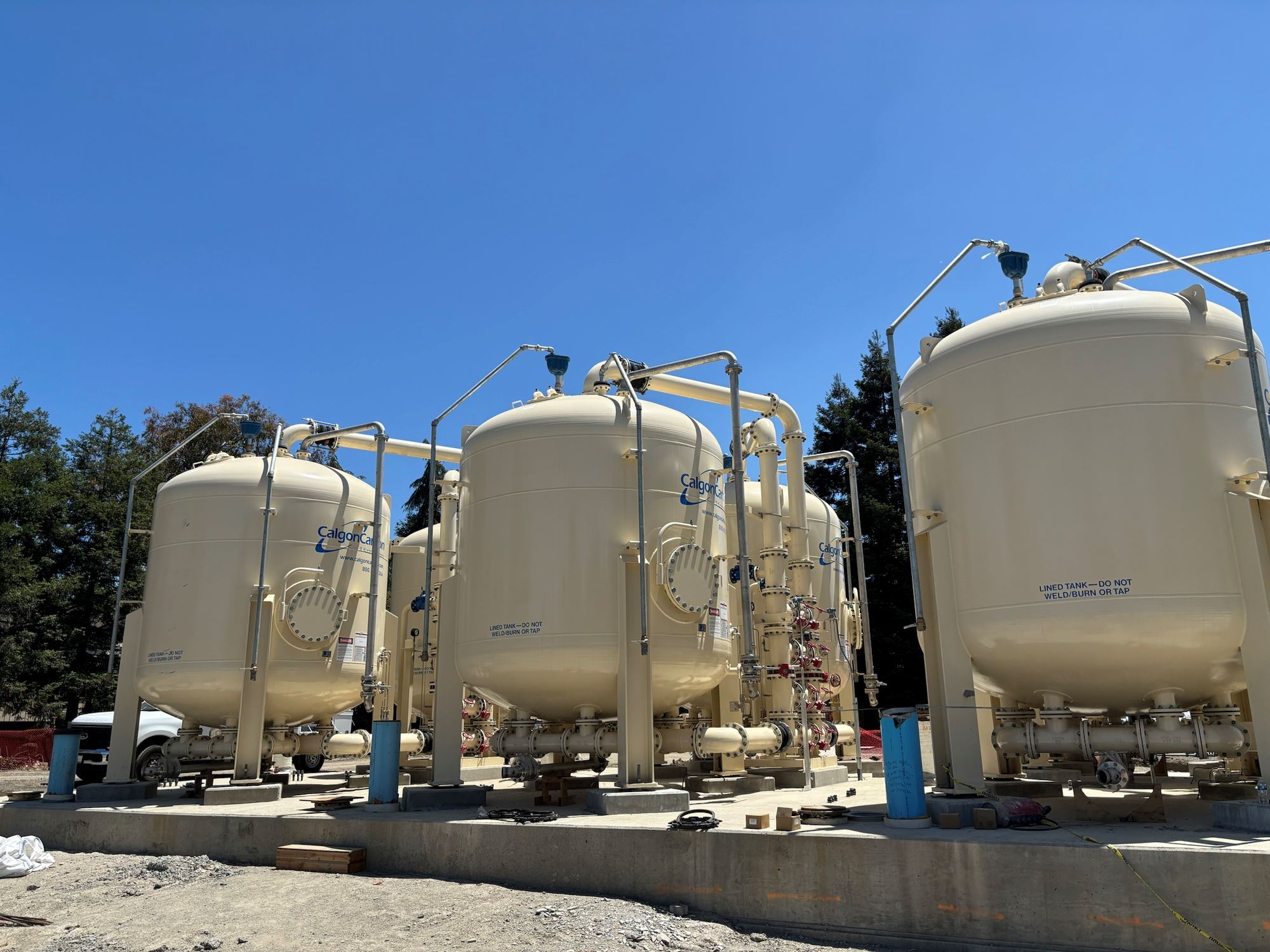
Ion exchange
Pressurised resin vessels. Overall installation size depends on capacity, the number of lines and operating conditions.
Example of an ACWD PFAS installation. Photo and description: Alameda County Water District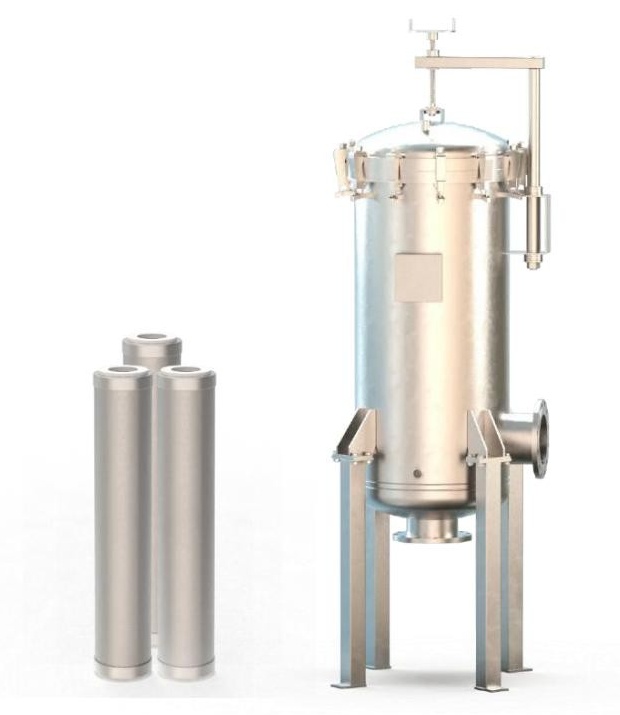
Modular cartridges and housings
Filter elements in a compact housing. Multiple units can be connected into a system to meet the required flow.
The difference starts with media volume.
At the same flow rate, required media volume depends on the permitted loading rate. Final system size also includes housings and maintenance space.
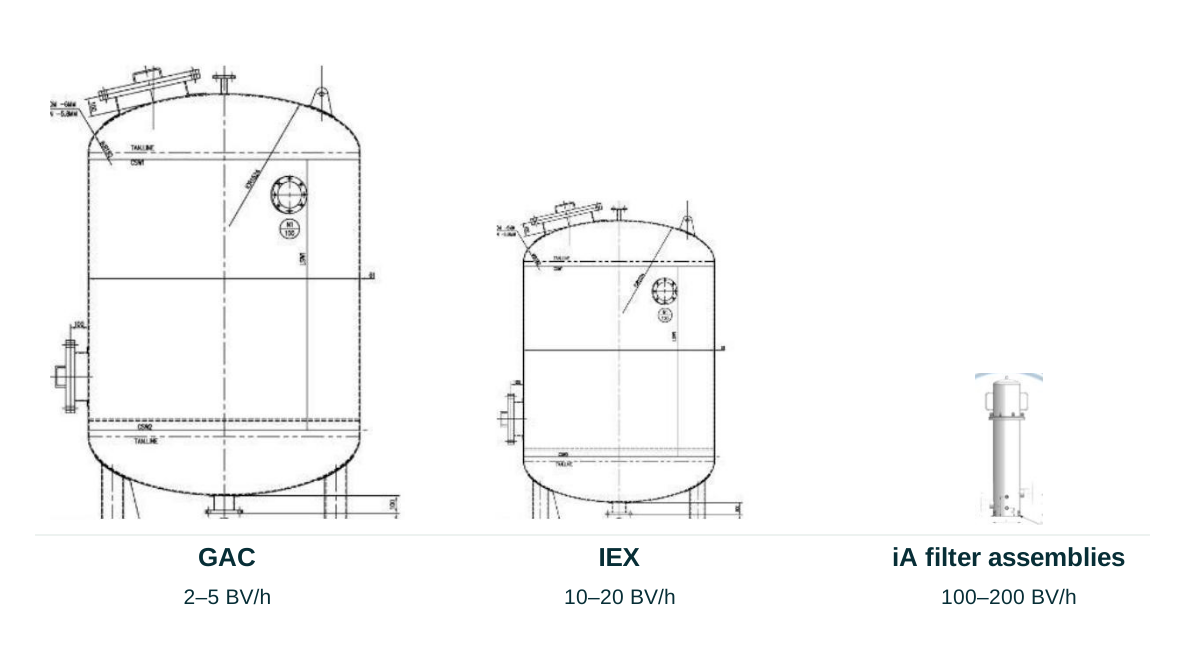
How much filter media is needed?
Indicative media volume for treating 120 m³ of water per hour.
All bars start at zero and use the same scale. The dark section shows the lower estimate and the light section extends to the upper estimate. This is media volume, not equipment size or footprint.